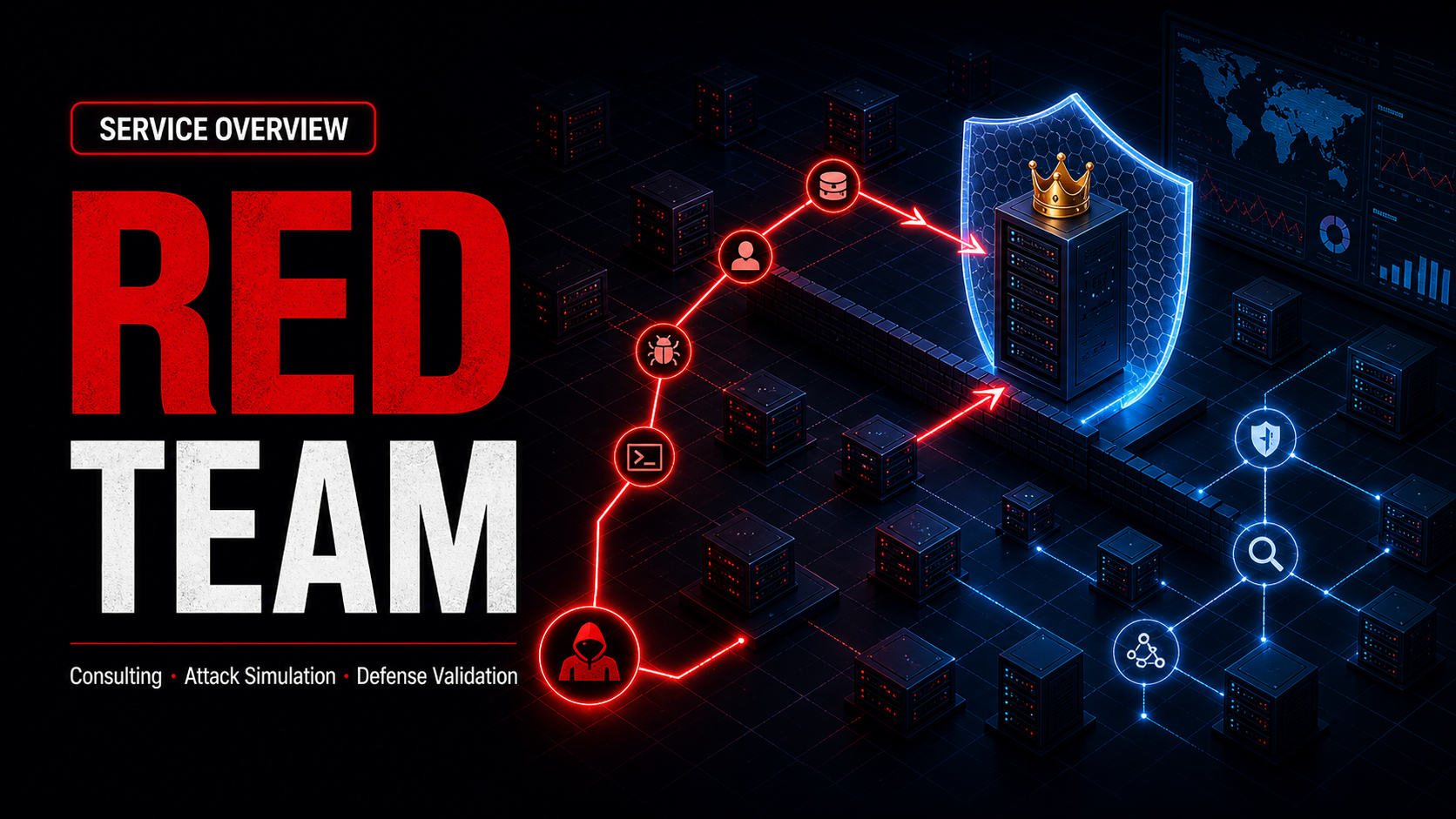
What Is Red Team Consulting? Differences from Penetration Testing, Adoption Criteria, Scope Definition, and Service Overview
Red team consulting is not a project for finding a handful of vulnerabilities. It is a decision-oriented security project that validates whether an organization’s critical assets can actually be reached or taken over from an attacker’s point of view. It matters to both security practitioners and executives because it reveals what simple scanning or checklist reviews often miss: time to compromise, attack chaining, and gaps in blue team detection.
For example, the CrowdStrike Global Threat Report repeatedly shows that attackers are moving faster after initial access. Red team consulting is therefore less about asking “what is vulnerable?” and more about asking “what can actually be compromised, how far can it go, when do we detect it, and how do we stop it?”
Red Team Consulting Attack Composition
Red team consulting does not simply list every possible ATT&CK technique. It selects the TTP combinations that are realistic in the target environment and validates whether they can form a coherent attack chain.
ATT&CK-based mapping example
TTPs matter when they can be connected in the real environment.The example below lays out candidate techniques by tactic and connects only the techniques that belong to a realistic intrusion scenario.What Does Red Team Consulting Validate?
The core of red team consulting is not the discovery of a single vulnerability, but the realism of an attack scenario. It validates the full flow: how an attacker could enter, which assets they would prioritize, which defenses they could bypass, and where privilege escalation or data theft could become possible.
It is commonly used to answer questions like these:
Where are our critical assets, and through which paths can they be reached?
What is the most realistic initial access vector from an external attacker’s perspective?
Can several weaknesses be chained together into an actual compromise?
At which stage do our existing security tools and monitoring processes detect the activity?
Do our response procedures and communication paths actually work after detection?
For this reason, red team consulting is not only a security team project. It becomes a validation effort that connects IT operations, development, monitoring, infrastructure, and sometimes executive decision-making.
How Is It Different from Penetration Testing?
One of the most common questions when considering red team consulting is how it differs from traditional penetration testing. In short, penetration testing focuses on technical vulnerability validation for specific assets, while red team consulting focuses on whether attack objectives can be achieved and whether defensive operations can respond effectively.
Category | Penetration Testing | Red Team Consulting |
|---|---|---|
Main purpose | Identify vulnerabilities | Validate realistic attack scenarios |
Scope | Asset-by-asset assessment | Objective-based attack chain validation |
Deliverables | Vulnerability list, reproduction steps, remediation guidance | Attack paths, blue team detection gaps, response improvements |
Operational view | Technical team centered | Includes security, monitoring, operations, and internal processes |
Key question | What is vulnerable? | What can actually be chained, and where is it stopped? |
For example, if the immediate need is to assess web application vulnerabilities, a penetration testing service may be the better starting point. If basic assessments have already been performed and the question is whether a real attacker could chain weaknesses to reach key systems, red team consulting is the better fit.
In other words, penetration testing asks whether a door can be opened. Red team consulting asks what happens after that door is opened, when the organization notices, and how far the attacker is allowed to go.
Organizations That Need Red Team Consulting, and Those That May Not Yet Be Ready
Not every organization needs to begin with red team consulting. However, the timing may be right when the following signals appear:
Internet-exposed assets are increasing quickly.
SaaS, cloud, VPN, and external partner connections have become complex.
Regular penetration tests are performed, but operational chain validation is limited.
Alerts exist, but blue team decision-making and response processes are unclear.
The organization wants to understand real risk through measurable scenarios.
On the other hand, if the organization still lacks a basic asset inventory, account policy, log collection, or vulnerability management process, it is usually better to strengthen foundational security operations first. Red team consulting is not a replacement for basic assessment. It is a more advanced stage for organizations that already have some operating model and want to validate real-world attack feasibility in a more complete way.
As the IBM Cost of a Data Breach report shows, the cost of an incident is not limited to technical recovery. It can also involve operational disruption, legal response, reputation damage, and communication costs. Red team consulting should therefore be viewed as a management decision tool for protecting critical assets, not just another technical assessment budget item.
What Must Be Agreed During Scope Definition?
The quality of a red team engagement is often determined by scope definition as much as by technical execution. The most important part is defining the Rules of Engagement in practical terms.
At minimum, the following items should be agreed in writing before the engagement begins:
Target assets and highest-priority protected assets
Allowed initial access vectors and prohibited areas
Whether social engineering is included
Limits for activities that could affect availability
Communication paths and stop conditions after detection
Retesting and follow-up improvement scope
A broad request such as “try everything” often makes the result less useful. The goal should be clear: executive reporting, monitoring maturity validation, cloud attack surface validation, internal privilege escalation review, or another defined decision objective.
Good red team consulting should be able to explain not only whether the team succeeded, but also what was validated, why it mattered, where the path stopped, and how the result connects to business risk.
What Deliverables Should Be Produced?
A red team report should not end as a simple vulnerability list. At minimum, it should include the following four dimensions.
1. Attack Flow Summary
The report should summarize initial access, expansion, privilege escalation, and objective completion in a way that executives and non-technical stakeholders can understand.
2. Technical Details and Evidence
It should include reproducible logs, screenshots, attack chain steps, ATT&CK mapping, detection status, and related configuration evidence.
3. Operational Gap Analysis
The report should identify where detection was missed and, even when detection occurred, why it did not lead to effective response.
4. Priority-Based Improvement Plan
Recommendations should not simply say “fix everything.” They should provide priorities, responsible teams, and execution guidance across 30, 60, and 90 days.
Ultimately, a good deliverable is not a document only the security team can read. It should help operations teams and executives decide what to do next.
Why ATT&CK Mapping and Purple Team Collaboration Matter
One of the most common missed opportunities after red team consulting is failing to connect the results back to the blue team. If an attack scenario was executed, it should be translated into MITRE ATT&CK terms and handed over as detection logic and response playbooks.
The important questions at this stage include:
Which tactics and techniques actually succeeded?
Which logs existed but had no detection rule?
Why were triage and escalation delayed even when detection occurred?
Which assets produced no useful logs at all?
This is why a purple team follow-up is valuable after red team consulting. If the red team proves an attack path, the next step is to improve detection and response so the same path cannot work in the same way again.
Why AI Red Teaming Should Be Considered Separately
As AI capabilities become part of business services, traditional red team scope is often no longer enough. Risks such as prompt injection, system prompt leakage, tool misuse, permission delegation mistakes, and business decisions based on unsafe model output are not always exposed through conventional web vulnerability testing.
Organizations using AI should therefore evaluate AI red teaming as a distinct perspective alongside general red team consulting.
Which inputs make the model behave unsafely?
Where do external data sources and tool calls cross privilege boundaries?
How could incorrect output affect real business processes?
Are prompt protection, data separation, and approval workflows sufficient?
This area is worth reviewing alongside frameworks such as the NIST AI RMF. The faster AI features are added ahead of security controls, the more AI red teaming becomes a practical readiness check rather than an optional exercise.
Frequently Asked Questions
Is red team consulting always better than penetration testing?
No. If the priority is vulnerability assessment for specific assets, penetration testing is more suitable. Red team consulting is more effective after basic assessments, when the organization wants to understand realistic attack scenarios and operational gaps.
How often should red team consulting be performed?
It depends on how quickly the organization changes. It is worth reconsidering after major infrastructure changes, large releases, mergers and acquisitions, SaaS expansion, or cloud reconfiguration.
Should we use external consulting or build an in-house red team?
In the early stage, external red team consulting is often the most realistic way to gain an objective perspective. Later, selected scenarios can be repeated internally as part of ongoing validation.
Conclusion
Red team consulting is not simply an exercise in imitating attackers. It is an operational security decision project that clarifies which attack paths are realistic for critical assets, whether current detection and response processes actually work, and what should be improved first over the next 90 days.
If your organization already performs basic vulnerability assessments but still wants to know how far a real attack could go, it may be time to consider red team consulting.